"Essential Owls" is a series of features highlighting former FAU student-athletes who are working in a host of professions attempting to stem the impact of the COVID-19 virus.
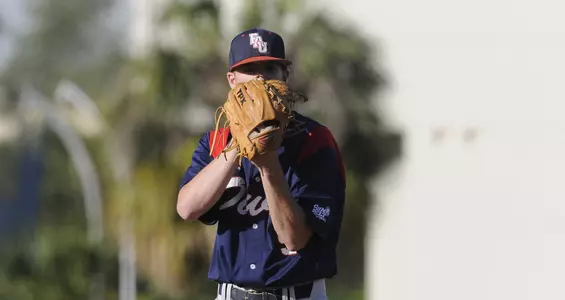
The next subject of our series, "Essential Owls," is focused on former FAU baseball player Kevin Alexander, a firefighter that recently transitioned to the Miami-Dade Fire Rescue Department.
On March 7, Kevin Alexander began work at his "dream department," Miami-Dade Fire Rescue. Less than a week later, for all intents and purposes, the world as Alexander and everyone else knew it turned upside down.
Alexander's path to MDFR's Battalion 7, and onto the front line of the current climate in which we live, was a winding road, initially formed by a foundation set at Florida Atlantic University.
Alexander came to FAU, and to the Owls' baseball team, as a local product from nearby Coral Springs. After a stellar prep career at J.P. Taravella High School, which included Second Team All-State and First Team All-County honors following his senior season, he quickly found FAU to be his college choice.
"I was playing on my summer team with the Florida Bombers, and Coach Mac (
John McCormack) and Coach (Jason) Jackson would come to my tournaments. Specifically the one that I think closed the deal was a tournament at UCF where I threw a complete game shutout. Coach Mac invited me for an official visit, I loved the coaching staff and the campus, and I loved the fact that it was close enough to home to where my parents could come and watch all the games, but I was yet far enough from home to where I still got the college experience. After that visit, it just seemed like a perfect fit and I told them that day that I was coming here."

He would join the Owls as a freshman in the fall of 2009, serving as both a starter and reliever for the '10 season. After a year off due to injury, he returned and became a key member of the staff, ultimately voted by his peers as team captain ahead of his final season. That coincidentally was the finest year of his five-year career, as he led the team with seven saves, tied for the team lead with five wins, and did not allow an extra base hit in 30 2/3 innings. He pitched to a 2.05 ERA and held opposing hitters to a .209 batting average.
Soon after the 2014 campaign ended, Alexander both earned his degree from FAU (with a double major in finance and business management), and signed a contract with the St. Louis Cardinals. The latter not only gave him the opportunity to continue his baseball career, but also allowed him for a time to compete locally, including in Jupiter at a couple of different levels within the organization.
"It was about two or three weeks after our season ended, I continued to throw bullpens because I was trying to get picked up. And I know Coach Mac was working hard for me as well. I was actually working baseball summer camp for FAU, and he pulled me out of camp one day and said he thought the Cardinals were going to sign me. We went into his office, I had a conference with them, and I signed with them the next day. They kept me in Jupiter, in the Gulf Coast League, then I got called up to State College (in Pennsylvania, the Cardinals' Short 'A' team) for the playoffs. I rejoined (former FAU teammate) Austin Gomber, and we played up there together.
"The second season was an unreal experience and was pretty eye-opening. I got called up again, to High-A (to play for the Palm Beach Cardinals), which was once again in Jupiter. That was the best competition I'd ever played against. Up until then I had played very well, but I quickly realized that I had to work even harder to even compete with those guys. It was both an extremely good opportunity and an eye-opening experience at the same time."
Even though Alexander would leave the professional baseball world after the 2015 season, his two years within the Cardinals' organization was successful statistically: a 3.24 ERA in 52 games and 75 innings, and 69 strikeouts against only 19 walks across multiple minor league levels. Though one door closed, another quickly opened because of his success off the field, in the classroom.
"I was very fortunate, Coach Mac was one of those people that preached 'student-athlete' being student coming before an athlete. At that time, a lot of the guys maybe didn't really agree with that, but Coach Mac was obviously wiser than us all, and looking back on it, I really appreciate that part about him. I always agreed with what he had to say, because I knew he knew best.
"I had invested so much of life into baseball that I thought it was going to be pretty detrimental to me, but it ended up not affecting me as much as I thought. I was offered by a few other teams to continue playing, but I was 25, and I looked at myself and said, 'do I want to mess around in the minor leagues for another two or three years and then start a career, or do I want to start a career now?' I really had to take some time to think about that, and I decided to go ahead and start a career and put in job applications for things I was interested in, and not continue the baseball path. Which was obviously a really difficult decision."
However, the first door post-baseball didn't mesh well with what Alexander had become accustomed to, meaning a second door became quickly necessary.
"I ended up getting a desk job, and I only lasted about six months. I went from 10 hours a day in the locker room, on the field, playing a game to 10 hours a day sitting behind a desk being stagnant. I felt myself withering away, (but then) I went out to dinner with my brother, a firefighter at the time. He said I should look into firefighting. It's the best job in the world … it's got the team camaraderie, great schedule, keeps you active and in shape. I looked into it for about two weeks, I got up from my desk job one day, I quit, and I went right to Fire Academy."
That quick pivot meant Alexander went pretty much immediately to class in Coral Springs, and he remembers the exact date that began: January 7, 2017.
He would take part in the academy's full-time accelerated class, Monday through Friday, 7 a.m. to 5 p.m. That lasted until April, and a week later, he began EMT training that concluded in August. He would be hired right out of the academy in October of 2017 by Polk County Fire Rescue. While there, Alexander began the application process for MDFR. He describes the transition taking about two and half years because MDFR is an "extremely well-developed fire department," and still then, COVID-19 nearly derailed the process.
"They put you through a training academy, and there was talk about our class not even being hired and them pushing us back. Which was scary (for me), because I had already given (Polk County) my two weeks' notice. We really didn't know what was going to happen, but they stuck with our class and made it work. I'm very grateful for it, it's literally the best job in the world.
"It's actually supposed to be a 14-week academy, and they do live burns, medical training, fire scenarios, etc. We got shortened to about 11 weeks, and it was less class days physically at the academy because we did a lot of online things too, which they had never done before. We did a lot of Zoom meetings for training because the academy decided they didn't want us there every single day. Because of the virus, they limited our time there."

Alexander "hit the field," as he said, on May 25. This time not as a baseball player, but as a Miami-Dade firefighter. But that date of course comes right in the middle of a global pandemic, which still now means a host of new protocol and safety procedures.
"It has changed everything. Before on calls, we were only required to wear protective gloves and maybe safety glasses depending on the call. But now on any call, you have to wear a minimum of two pairs of gloves, protective Tyvek sleeves, glasses and an N95 mask. And if the patient is positive for (COVID-19), we have to wear all of that, plus a Tyvek gown and face shield. So we're taking extreme precautions.
Though he deals with COVID-19 every day that he is on shift, Alexander feels MDFR keeps him as safe as possible, with access to top-of-the-line protective gear and equipment. Even still, he makes sure to take advantage of all the protection afforded to him.
"It's in our standard operating procedures that we are required (to wear the gear), and it's the officers' due diligence to enforce it. I know I personally do on every call because I'm around friends and family, and just because I'm not affected, if I'm exposed to it all the time, I could be a carrier. I take all the precautions. Our department does regular testing at our headquarters at no charge, so all precautions are taken."
Alexander's headquarters is Battalion 7, serving mostly (but of course not limited to) Homestead and Cutler Bay. He now has three years under his belt as a firefighter, and has spent the last four months in the midst of both an adjustment to his new department and the unknowns of the virus we are living amongst. On the frontline, Alexander has a first-hand view of COVID-19, and has a clear message to send.
"Wear a mask and wash your hands, because all of the limitations that are being put on society right now are only going to get worse if we continue unsafe practices. By wearing a mask and following all the CDC and county guidelines, it's just going to make things better and help prevent the spread."